Egyptian pharaoh’s tomb discovered by American archaeologists
The Art Newspaper
January 6, 2014
The important find is the burial site of Sobekhotep I, believed to be the first king of the 13th Dynasty.
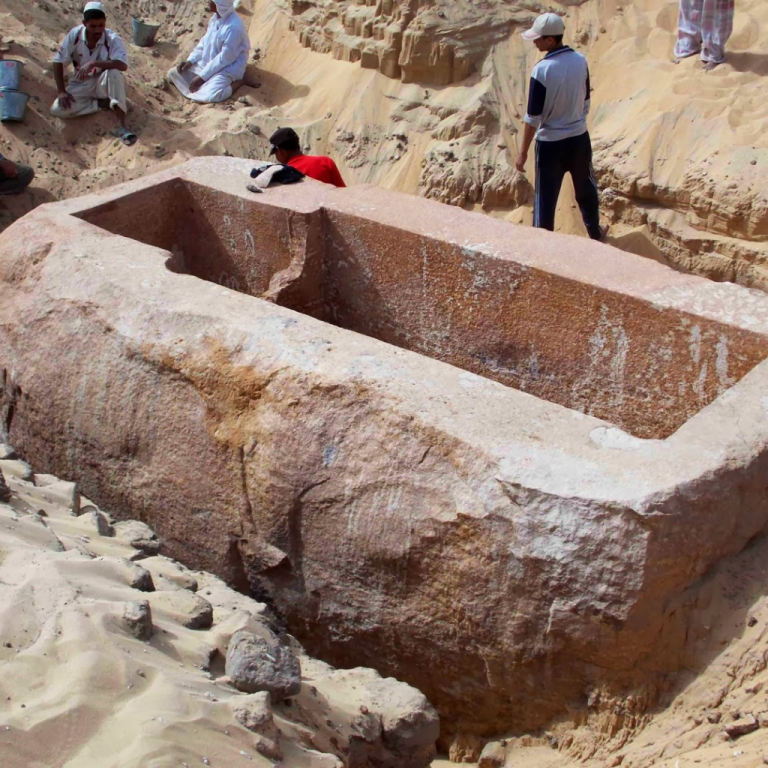
The tomb of the Egyptian pharaoh King Sobekhotep I, believed to be first king of the 13th Dynasty (1781BC-1650BC), has been discovered by a team from the University of Pennsylvania at Abydos in Middle Egypt, 500km south of Cairo.
Since new royal tombs are rarely discovered, and as only ten from the 13th Dynasty are known—all at Dahshur, just south of Cairo—this is an important find. King Sobekhotep I ruled for
only about three years, at a time when Egypt was entering a period of decline. In fact, the chronological evidence for this period is so complex that scholars are still debating the order of the 13th Dynasty kings.
Sobekhotep I’s tomb was constructed from limestone brought from the Tura quarries near modern Cairo, while his burial chamber is made from red quartzite. The burial was originally topped by a pyramid. Among the further finds are a 60-ton quartzite sarcophagus, a stele bearing the name of the king, an image of Sobekhotep I enthroned, parts of the canopic jars that once contained the pharaohs internal organs, and funerary objects.
Excavation at the tomb is ongoing, though Egypt’s antiquities chief, Mohamed Ibrahim, hopes to open the site to the public, once the tomb has been restored.
This is not the only discovery of an ancient Egyptian site since the New Year. Working at Luxor, a team from Japan’s Waseda University uncovered the tomb of Khonsu-em-heb, an overseer of granaries and beer-brewers for the goddess Mut during the Ramesside Period (1298BC-1069BC). The tomb walls are painted with many beautiful scenes that illustrate religious ceremonies and show the tomb’s owner, Khonsu-em-heb, with his wife and daughter, who were both chantresses of Mut. The Japanese team uncovered the tomb while clearing the courtyard of another nearby burial site.
Update, 15 January 2014
Another tomb, this time of a previously unknown pharaoh named Seneb-Kay, was also unearthed at Abydos, Egypt, by the same team from the University of Pennsylvania.
Although relatively small, and constructed from reused blocks dated to the Middle Kingdom (2066BC-1781BC), the tomb was originally richly equipped with gilded funerary equipment, fragments of which were found during excavation. The king's skeleton, canopic jars, fragments of the wooden coffin and cartonnage funerary mask, which was probably gilded and later stripped of its decoration by tomb robbers, were also found within.
Seneb-Kay appears to have ruled as a regional king at Abydos during Egypt's Second Intermediate Period (1781BC-1549BC), a time when central government power had broken down and the kingdom's unity had fragmented.
Related articles
BAR International series
Rawi: Egypt's Heritage Review
- What did Egypt's Pharaoh do Each Day? (December 2013)
- The curious tale of King Seqenenre Tao (July 2013)
- Delta Blues: A day at Pi-Ramesses and Tanis (June 2012)
- Akhenaten's Akhetaten: A day at Tell el-Amarna (June 2012)
The Art Newspaper
- Ancient physician's tomb discovered in Egypt (October 2013)